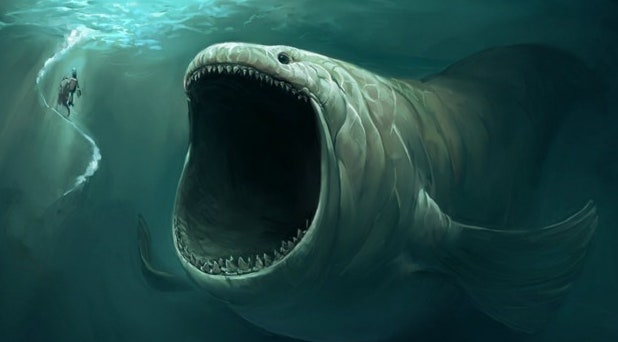
The image depicts one of humanity’s oldest and most powerful fears: the idea that something impossibly large might be hiding beneath the ocean.
At first glance, the scene is almost simple. A lone diver floats in a vast underwater world, surrounded by cold blue-green water. A trail of bubbles rises toward the surface, suggesting that the diver has only recently descended into the depths. Then the eye is drawn to the enormous creature approaching from the darkness.
Its scale is almost absurd.
The diver is so small in comparison that the creature does not merely look like a large fish. It looks like an entire living structure moving through the sea. Its head alone appears large enough to swallow the diver without effort, while the rest of its body disappears into the darker water behind it. This is important because the unseen portion of the animal makes it even more frightening. The viewer cannot determine exactly where the creature ends.
Its most striking feature is its mouth.
The jaws are opened extraordinarily wide, forming what looks like a black tunnel surrounded by rows of sharp teeth. Instead of immediately attacking, however, the monster seems to be approaching with its mouth already open. That creates an unsettling question: is the diver being hunted, or has the creature simply encountered something so small that it barely recognizes it as prey?
That difference makes the scene far more disturbing.
A normal predator attacking a human is frightening because the animal wants to kill us. A creature of this size is frightening for another reason entirely: it might not even need to want to kill us.
To such an animal, a human being could be little more than plankton.
The Fear of Enormous Creatures
Images like this often trigger a combination of several psychological fears.
One is thalassophobia, the fear or intense discomfort associated with deep or vast bodies of water. The ocean is particularly effective at producing this feeling because humans cannot see very far underwater. Even in relatively clear water, visibility eventually fades into blue, green, or black.
That means the ocean contains something the human brain strongly dislikes: invisible space.
When standing in a field, we can usually see what is approaching us. In a forest, trees may block our vision, but we still understand roughly where the ground and horizon are.
Underwater, there may be hundreds or thousands of meters of empty space beneath you.
And theoretically, something can approach from almost any direction.
Above.
Below.
Behind.
Or directly out of the darkness.
The enormous creature in this image takes advantage of that uncertainty. Most of its body is partially obscured, forcing the imagination to complete the missing information.
The result is often more frightening than showing the entire monster.
There is also another fear sometimes associated with images like this: megalophobia, the fear or unease caused by extremely large objects.
A blue whale is already difficult for the human mind to comprehend. The largest individuals can reach roughly the length of a basketball court. Standing next to one would completely distort our normal understanding of biological scale.
Now imagine something several times larger.
At that point, the creature stops feeling like an animal and begins to feel like geography.
Its back might resemble a hill.
Its fins might resemble wings.
Its mouth might look more like the entrance to a cave than a biological structure.
That is exactly the visual language used in this image.
What If Such an Animal Really Existed?
Biologically, a creature exactly like the one depicted here would face enormous challenges.
Large animals require enormous amounts of energy.
The biggest living animal on Earth, the blue whale, solves this problem in a surprisingly elegant way. Instead of hunting enormous prey, it eats tiny organisms—primarily krill—in huge quantities.
This creates one of nature’s most interesting paradoxes:
The largest predator-sized animal on Earth survives by eating some of the smallest animals in the ocean.
There is a reason for this.
Chasing individual prey is expensive.
Imagine an animal weighing more than one hundred tons trying to accelerate, turn, and pursue large fish continuously. The energy cost would be tremendous.
Filter feeding is far more efficient.
A giant animal can simply swim through enormous concentrations of small organisms and collect thousands or millions of them at once.
This raises an interesting possibility about the monster in the image.
Despite its terrifying teeth, a truly enormous ocean creature might not need to hunt humans at all.
A human diver might contain too little energy to be worth chasing.
In fact, the monster could potentially be more dangerous because of its indifference.
Imagine swimming beside an animal so large that the movement of its tail creates currents powerful enough to throw you dozens of meters.
It might never attack you.
It might accidentally kill you simply by turning around.
The Real Ocean Has Produced Monsters Before
Although the animal in the image is fictional, Earth’s oceans have genuinely contained creatures that would appear monstrous to a modern swimmer.
One famous example is Megalodon, an extinct giant shark that lived millions of years ago.
Scientists estimate that very large individuals may have reached around 15 to 20 meters in length, although exact maximum estimates remain debated.
Even conservative estimates make Megalodon enormous.
A modern great white shark might reach around five or six meters in exceptional cases. Megalodon could potentially have been several times that length and enormously heavier.
Its prey included marine mammals, and fossilized whale bones have been found bearing enormous bite marks.
Imagine seeing such an animal underwater.
You probably would not experience it the way movies usually portray shark attacks.
The first thing you might notice would simply be a shape.
A large shadow moving through the blue.
Then the shape would continue getting larger.
And larger.
Until your brain finally understood that the “shadow” was an animal.
There were also enormous marine reptiles during the age of dinosaurs, including mosasaurs.
Mosasaurs were not dinosaurs themselves but giant marine reptiles related, in evolutionary terms, to modern lizards and snakes. Some species reached lengths comparable to large modern whales.
The ancient oceans also contained enormous predatory fish, giant squid-like animals, armored fish, and marine reptiles with long necks or enormous jaws.
The ocean has repeatedly demonstrated that when ecological conditions allow enormous predators to evolve, evolution is perfectly capable of producing them.
Why People Once Believed in Sea Monsters
For most of human history, sailors had very little understanding of what lived in the deep ocean.
Imagine being a sailor five hundred years ago.
There are no submarines.
No underwater cameras.
No sonar.
No marine biology textbooks.
You are crossing an ocean that may be thousands of meters deep.
At night, you hear enormous splashes beside the ship.
Occasionally, something gigantic surfaces.
Perhaps you see a whale for only two seconds.
A huge black back emerges from the darkness.
Then disappears.
Another sailor claims he saw a massive tail.
Someone else sees tentacles.
Months later, the story has changed.
The whale becomes larger.
The tentacles become longer.
Eventually, the creature is capable of dragging entire ships beneath the waves.
This is probably how many sea monster legends developed.
Importantly, some legendary creatures may have been inspired by real animals.
The giant squid is a perfect example.
For centuries, stories described enormous tentacled monsters such as the Kraken.
Modern science later confirmed that genuinely enormous squid do exist.
Giant squid can reach extraordinary lengths, largely because of their extremely long tentacles.
There is also the colossal squid, a different species that is shorter overall but much heavier and more heavily built.
Suddenly, old sailors describing enormous tentacles rising from the ocean do not sound completely ridiculous.
They may have exaggerated.
But they may also have seen something real.
That is one of the most fascinating aspects of sea monster mythology.
Sometimes mythology begins where observation ends.
A sailor sees five percent of an animal.
Human imagination creates the remaining ninety-five percent.
The Deep Sea Makes the Idea Even More Interesting
More than half of Earth’s surface is covered by deep ocean.
Much of it is extremely difficult to observe directly.
The deepest parts of the ocean are under crushing pressure, completely dark, and extremely remote.
Animals living there have evolved strange adaptations.
Some produce their own light through bioluminescence.
Some have enormous mouths compared with their bodies.
Some have expandable stomachs.
Some possess transparent tissues.
Others look so unusual that if they appeared in a fantasy film, audiences might complain that the creature design was unrealistic.
The deep sea teaches us an important lesson:
Evolution does not care whether something looks normal to humans.
If a bizarre body shape helps an organism survive, evolution can produce it.
This is partly why fictional images like this feel strangely believable.
We know that the specific monster probably does not exist.
But we also know that the ocean regularly produces animals stranger than anything humans would intuitively design.
A Thought Experiment: The Diver’s Perspective
Now imagine the scene from the diver’s perspective.
You are thirty meters below the surface.
The water temperature is cold but manageable.
Your breathing sounds unusually loud because everything else is quiet.
Inhale.
Exhale.
Bubbles.
Inhale.
Exhale.
Bubbles.
Your visibility is perhaps twenty or thirty meters.
Beyond that distance, everything becomes blue-green haze.
Then something changes.
At first you cannot explain what it is.
The water seems darker ahead of you.
You assume it is a rock formation.
But the darkness moves.
Slowly.
You stop swimming.
The shape continues approaching.
Then you notice something terrifying.
The “rock” has an eye.
At this moment, your brain struggles with scale.
You think the creature must be closer than it appears because animals are not supposed to be that large.
But then you notice the distance between its eye and its mouth.
The geometry makes no sense.
Your mind recalculates.
The animal is not ten meters away.
It is much farther away.
It is simply enormous.
Then its mouth opens.
From where you are floating, the inside does not resemble a mouth.
It resembles a room with teeth.
This may be the most terrifying moment imaginable—not necessarily because death is certain, but because your understanding of the natural world has suddenly collapsed.
You have discovered that something exists that science does not know about.
And you are close enough to touch it.
The Creature Might Not Be Hunting You
There is another interpretation of the image that makes it even more interesting.
What if the creature is not attacking?
Many large marine animals feed by opening their mouths while moving forward.
If this fictional animal were some kind of giant filter feeder, the scene could represent an accidental encounter.
Imagine that it normally feeds on massive schools of fish or dense concentrations of plankton.
The diver happens to be directly in its path.
To the creature, the diver might be almost invisible.
The monster is not angry.
It is not aggressive.
It does not even know the diver is there.
That would create a very different type of horror.
Predators are understandable.
They hunt.
They choose targets.
They attack.
But nature is often far more dangerous when it is completely indifferent.
A tsunami does not hate you.
An avalanche does not hunt you.
A hurricane does not know you exist.
An enormous animal could possess the same terrifying indifference.
Could Something This Large Remain Undiscovered?
This question appears frequently whenever people discuss hypothetical sea monsters.
The answer depends heavily on size.
The ocean is enormous, but very large animals leave evidence.
They need food.
They reproduce.
They die.
They produce biological material.
They interact with ecosystems.
Large air-breathing animals must eventually surface.
Modern sonar, satellite monitoring, fisheries, underwater microphones, research vessels, environmental DNA sampling, and countless commercial ships make it increasingly difficult for an enormous population of unknown animals to remain completely hidden.
A single mysterious animal might theoretically avoid observation for some time.
But an entire breeding population of gigantic monsters would be much harder to conceal.
That is an important point.
Species do not normally exist as one immortal individual.
They need populations.
A sustainable population might require hundreds or thousands of individuals distributed across an ecosystem.
At that scale, evidence becomes increasingly difficult to hide.
So an animal the size depicted in the image is extremely unlikely to exist unnoticed in the modern ocean.
But that scientific conclusion does not make the image less powerful.
In some ways, it makes it more interesting.
Because the picture represents not what scientists expect to find—but what the human imagination fears might exist beyond the limits of observation.
Why Giant Sea Monsters Are More Frightening Than Giant Land Monsters
There is an interesting psychological difference between giant creatures on land and giant creatures underwater.
Imagine a gigantic dinosaur walking toward you across a field.
Terrifying?
Absolutely.
But you can see it.
You understand where the ground is.
You can estimate its direction.
You can potentially hide behind something.
Now imagine an equally large animal underwater.
You may not see it until it is close.
You cannot run.
Your movement is slow.
Your oxygen is limited.
Sound behaves differently.
Visibility is limited.
You cannot easily determine distance.
And there may be kilometers of water beneath you.
This environment removes most of the sensory advantages humans normally rely on.
Humans are terrestrial animals.
We evolved to understand landscapes, not three-dimensional underwater space.
The ocean therefore transforms even ordinary animals into something mysterious.
A shark appearing twenty meters away underwater can feel more threatening than a much larger animal seen hundreds of meters away on land.
Now increase that shark’s size by a factor of ten.
That is essentially the psychological trick performed by this image.
An Ancient Instinct
There may also be something evolutionary about our reaction to images like this.
Human ancestors spent millions of years avoiding predators.
Large eyes.
Large jaws.
Sharp teeth.
Sudden movement.
Dark hiding places.
These visual signals are immediately understood by the brain.
We do not need to consciously calculate:
“That animal has a high probability of causing bodily injury.”
The emotional system reacts first.
Then rational thought follows.
The creature in this image exaggerates almost every predator signal imaginable.
Huge mouth.
Numerous teeth.
Forward-facing approach.
Unknown body size.
Low visibility.
No obvious escape route.
And an environment in which the human is physically disadvantaged.
It is almost a perfect recipe for instinctive fear.
The Most Disturbing Possibility
Perhaps the most interesting thought inspired by this picture is not whether enormous monsters exist today.
Instead, consider this:
What if something similar existed millions of years ago and left almost no fossil evidence?
Fossilization is rare.
Most organisms that have ever lived did not become fossils.
Bodies decay.
Bones dissolve.
Ocean crust is recycled through geological processes.
Many deep-sea environments are particularly poor places for long-term fossil preservation.
Because of this, paleontologists know that the fossil record represents only a fraction of Earth’s biological history.
That does not mean kilometer-long sea monsters once existed.
There are strong biological constraints on animal size.
But it does mean that entire lineages of strange marine animals may have existed without leaving fossils that humans have discovered.
Some may have looked completely unlike anything alive today.
The history of life is much larger than the history we have reconstructed.
Every fossil discovery is therefore a tiny window into an enormous lost world.
A Final Story
Imagine that the photograph was real.
A deep-sea expedition disappears during a routine survey.
Several weeks later, the research vessel is found drifting hundreds of kilometers away.
There is no crew aboard.
Most of the scientific equipment is intact.
One underwater camera contains a damaged memory card.
Researchers recover only twelve seconds of footage.
For the first eight seconds, nothing unusual appears.
A diver is visible swimming through open water.
Then the diver suddenly stops.
The camera turns toward the darkness.
At first the researchers see what looks like an underwater cliff.
Then the cliff blinks.
The footage shakes.
A massive mouth opens.
The screen becomes black.
The final audio recording contains no scream.
Only the regular sound of the diver breathing.
Then a strange low-frequency vibration begins.
It becomes louder.
And louder.
Until the recording ends.
Scientists initially estimate the visible head to be approximately thirty meters wide.
Later analysis suggests the estimate is wrong.
A researcher notices something in the background that everyone had assumed was sediment.
It is actually the creature’s body.
The revised estimate is much larger.
The government refuses to publish the report.
But one image leaks online.
It is the image shown above.
For several years, people argue about whether it is real.
Most experts call it a digital fabrication.
Eventually, interest disappears.
Then, decades later, a network of deep-sea hydrophones detects an unknown sound moving slowly across the Pacific Ocean.
The sound is too regular to be geological.
Too powerful to match any known whale.
And based on the time difference between recording stations, researchers calculate that whatever produced it was moving thousands of meters below the surface.
Someone compares the acoustic path with the coordinates of the original photograph.
They match.
The most disturbing part is not that the creature may still be alive.
It is that the sound was not coming from one animal.
There were several.
And they appeared to be moving toward shallower water.